Local detail
What Local Conditions Do
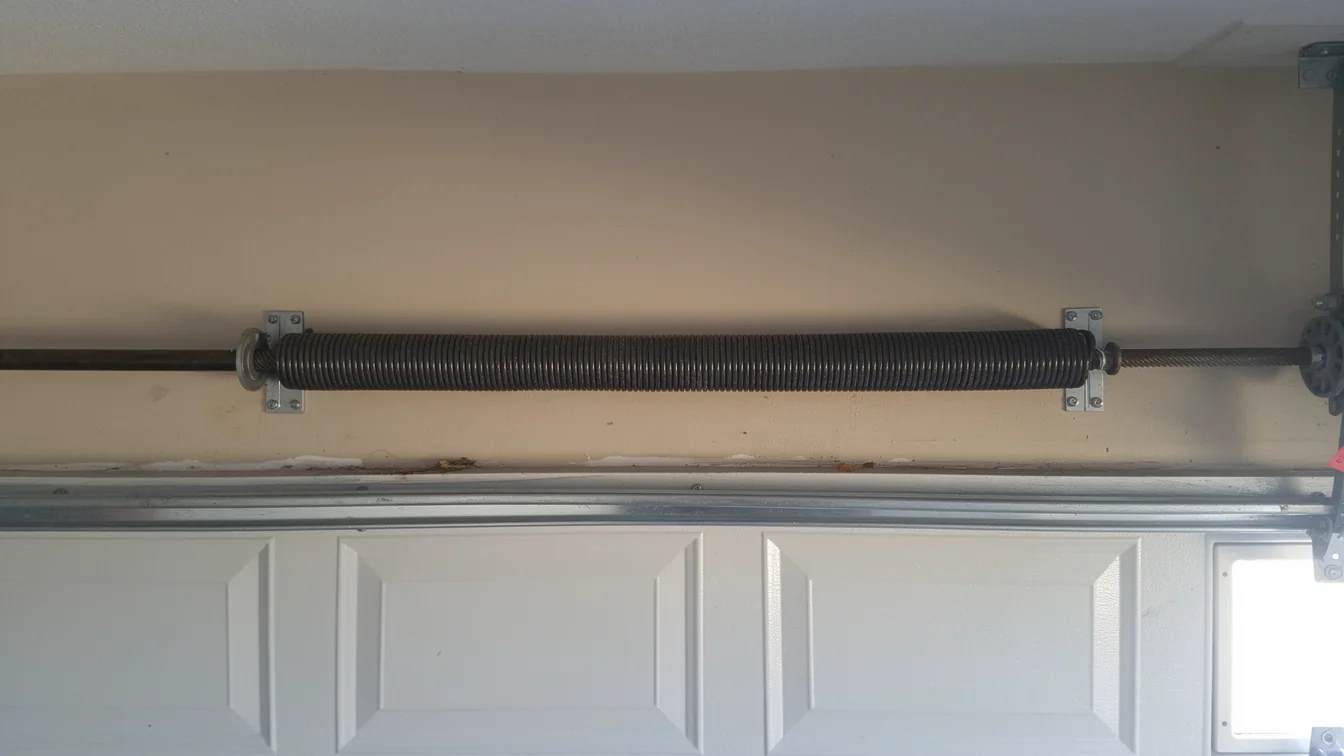
Garner sits in a cold-moderate climate band. It's not the hard freeze-thaw cycle you'd get further north, but there's still enough seasonal swing to matter on a garage door. Steel panels contract in the cold months and expand again in the heat, which loosens the screws holding hinges to track brackets over a few winters. Grease in a torsion spring stiffens overnight in cold weather and loosens up again by afternoon, which is part of why doors feel heavier first thing in the morning.
Housing in this part of the service area mostly went up between 1973 and 2013, with the median build year landing around 2001. That spread matters because it means we're working across a few different hardware generations on any given week - older torsion setups from the 70s and 80s next to the sectional steel doors that were standard on 2000s production builds. A service call on a house from each era looks different: older torsion springs are often undersized by today's cycle ratings, while the 2000s-era doors tend to have thinner steel skins that dent easier but usually have better-sealed weatherstripping.
We check for both when we're out - what the climate has done to the hardware, and what era of door we're actually looking at before we quote anything.
The area
Doing Nothing For Now
Not every noise or slow close needs a same-day call. If the door still closes all the way and the opener isn't straining or reversing on its own, a dry track or a squeaky roller can usually wait a few weeks - especially if the house is one of the 2000s-era builds common across this area, where the hardware is newer and has more life left in it.
What shouldn't wait: a door that drops faster than it used to, a cable that looks frayed, or a spring with a visible gap in the coil. Those are tension failures, and tension failures on a double door don't give much warning before the second spring or the opener's drive gear goes with it.
Honest limitation: we don't do same-day emergency calls as a guarantee. If your door is stuck shut with a car inside, we'll tell you that on the phone so you're not waiting on us with no plan. Most of what we see, though, is wear that's been building for months, not something that broke an hour ago - and that kind of call can usually be scheduled a few days out without the door getting any worse.
What we find
What Most People Get Wrong
The most common mix-up we see: people blame the opener when the real problem is the spring. If a torsion spring is weakening, the opener has to work harder to lift the door, and it starts to sound like the motor is dying. Replace the opener and the door still won't lift right, because the spring was the actual failure. This comes up a lot on houses from the earlier end of the 1973-2013 build range, where the original springs have simply outlasted their rated cycle count.
The other one: assuming a dent or bent panel is cosmetic. On the steel sectional doors common in the 2000s-era stock across this area, a bent panel usually also means a bent track rail behind it, which throws the rollers out of alignment. Ignore it and the opener starts pulling against resistance every cycle, which shortens the life of the drive gear.
Across the roughly 12,873 owner-occupied houses in this part of the service area, most of the repair calls we run are on doors between 15 and 25 years old - old enough for springs and cables to be near end of life, but not so old that the whole door needs replacing. Getting that diagnosis right the first time is most of the job.
How we work
The Problem
Put the pieces together and the core issue is this: a lot of Garner's housing clustered its construction in a fairly tight window - mostly 1973 to 2013, median around 2001 - which means a lot of garage door hardware is aging out at roughly the same time. Springs rated for a certain number of open-close cycles don't fail on a schedule, but they do fail in a predictable range, and a cold-moderate climate with daily temperature swings speeds that up slightly compared to a milder band.
At 25,222 households and a median income of $75,289 in this service area, most of what we see isn't someone replacing a door outright - it's someone fixing the specific part that failed on the door they already have: a spring, a cable, a section of track, a roller. That's the actual shape of a service call here. It's rarely one universal fix, because a 1970s torsion setup and a 2000s steel sectional door fail in different ways and need different parts on the truck.
We don't stock every part for every era of door - some older torsion hardware takes longer to source than the common 2000s sizes - so part of the call is telling you honestly what's in stock and what needs ordering.
Talk to a local pro
Garage door trouble in Garner?
Same-day service with honest, upfront quotes.